Margaux SCHMIED

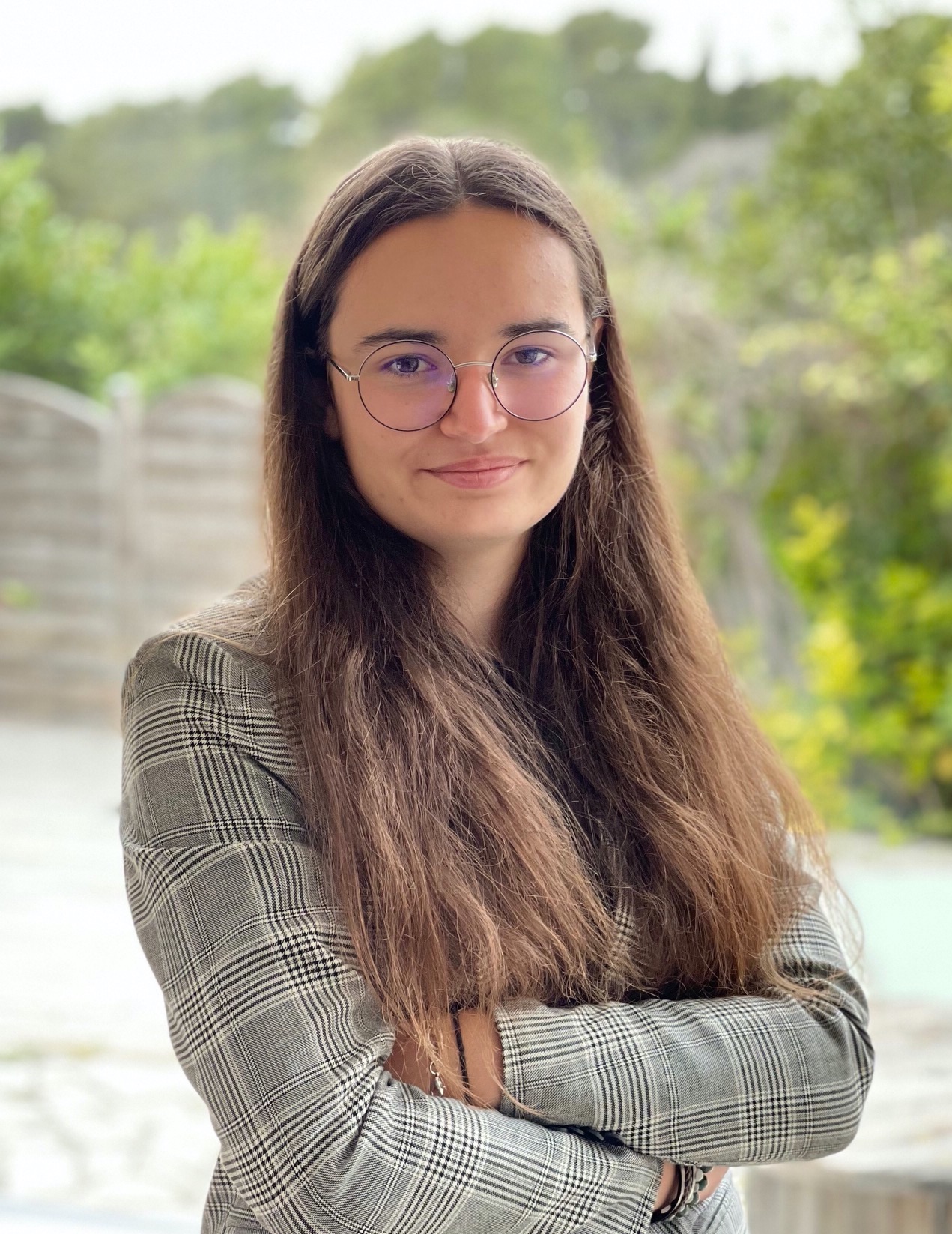
About Me (she/her)

I am a PhD student in computer science at the University of Côte d'Azur, specializing in constraint programming, algorithmics, operations research, and graph theory. Currently, I am the recipient of a 3IA scholarship, which supports my research at the I3S laboratory in the C&A team. My research is supervised by Jean-Charles REGIN, a recognized expert in the field.

My research focuses on constraint programming, combinatorial optimization, with a particular interest in graph and flow algorithms. I am especially interested in developing efficient algorithms for filtering algorithms and cost assignment problems, as well as exploring learning approaches for combinatorial optimization.
About Me Image

Publications

International Conferences

2026

The Distance Constraint on Sequence Variable

Margaux Schmied, Augustin Delecluse, Pierre Schaus, Jean-Charles Régin

CP 26

Insertion sequence variables have recently been introduced as a computational domain for modeling routing and sequencing problems in constraint programming. Typically, search heuristics guide the insertion process of new nodes into a partial growing path, while constraints eliminate infeasible insertions. This paper investigates filtering for the (minimum) distance constraint over insertion sequence variables. This global constraint links a sequence to a distance variable based on a given distance matrix. So far, only a simple filtering algorithm has been proposed, which considers the partial path but ignores mandatory nodes. Our contribution is to introduce stronger lower bounds that also take mandatory nodes into account. These bounds further enable the derivation of additional filtering rules for node insertions. An experimental evaluation on the \emph{TourMustSee} problem shows that the proposed filtering rules significantly reduce the search space compared to the existing filtering approach.

2025

Cryptarithmetic Playtime

Arnaud Malapert, Marie Pelleau, Margaux Schmied, Davide Fissore

ICTAI 25

A cryptarithm is a mathematical and logical puzzle in which words form an equation where the letters represent numbers to be determined in a given base. This problem is popular in recreational mathematics, education, and constraint programming. We propose a general, efficient and easy-to-use approach to solve this NP-Complete problem, as well as a hierarchical approach for their generation. The experimental evaluation has generated a large, diverse, and remarkable collection of new cryptarithms.

2024

Efficient Implementation of the Global Cardinality Constraint with Costs

Margaux SCHMIED, Jean-Charles REGIN

CP 2024

The success of Constraint Programming relies partly on the global constraints and implementation of the associated filtering algorithms. Recently, new ideas emerged to improve these implementations in practice, especially regarding the all different constraint.

In this paper, we consider the cardinality constraint with costs. The cardinality constraint is a generalization of the all different constraint that specifies the number of times each value must be taken by a given set of variables in a solution. The version with costs introduces an assignment cost and bounds the total sum of assignment costs. The arc consistency filtering algorithm of this constraint is difficult to use in practice, as it systematically searches for many shortest paths. We propose a new approach that works with upper bounds on shortest paths based on landmarks. This approach can be seen as a preprocessing. It is fast and avoids, in practice, a large number of explicit computations of shortest paths.

National Conferences

2026

Filtrage de la contrainte de distance pour les variables séquences

Margaux Schmied, Augustin Delecluse, Pierre Schaus, Jean-Charles Régin

JFPC 2026

Les variables séquence offrent un cadre compact pour modéliser les problèmes de routage et d’ordonnancement en programmation par contraintes, en construisant les solutions par insertions successives de nœuds dans une séquence partielle. Nous étudions la propagation d’une contrainte de distance sur ces variables et proposons de nouvelles bornes inférieures admissibles sur le coût de toute extension réalisable. Ces bornes, issues de relaxations du processus d’insertion, permettent de détecter et d’éliminer les insertions irréalisables. Des expériences sur le problème du voyageur de commerce avec fenêtres de temps et collecte de prix montrent que ces règles de filtrage réduisent significativement l’espace de recherche par rapport aux méthodes existantes.

2025

Amélioration de la contrainte globale de cardinalité avec coûts par l’introduction de points de repère

Margaux SCHMIED, Jean-Charles REGIN

JFPC 2025

Le succès de la programmation par contraintes repose en partie sur l’efficacité des contraintes globales et de leurs algorithmes de filtrage. Nous étudions ici la contrainte globale de cardinalité avec coûts, qui généralise la contrainte de différence en limitant le nombre d’affectations par valeur et en imposant une contrainte sur le coût des affectations. L’algorithme classique de filtrage repose sur le calcul systématique de plus courts chemins, ce qui le rend coûteux en pratique. Nous proposons une approche plus rapide, fondée sur des bornes supérieures obtenues via des points de repère (landmarks en anglais), réduisant ainsi significativement les calculs explicites nécessaires. Les expériences montrent que, dans le meilleur des cas, elle peut être en moyenne 57 fois plus rapide.

2023

Jouer avec des Cryptarithmes en Programmation par Contraintes

Arnaud MALAPERT, Margaux SCHMIED, Davide FISSORE, Marie PELLEAU, Ambre PICARD MARCHETTO

JFPC 2023

Un cryptarithme est un casse-tête mathématique et logique dans lequel des mots forment une équation où les lettres représentent des chiffres à déterminer dans une base donnée. Ce problème est populaire en mathématiques récréatives, dans l’enseignement, et en programmation par contraintes. Nous proposons une approche générale, efficace et simple d’utilisation pour résoudre ce problème NP-Complet. La suite naturelle est une approche hiérarchique pour leur génération. Les évaluations expérimentales ont engendré une vaste collection, variée et remarquable.

Distinctions

2025

  • Best Paper Award, ICTAI 2025

Scientific distributions

2026

  • Visit to Pierre Schaus during 5 weeks, at ICTEAM Université Catholique de Louvain-La-Neuve, Belgium
  • "Solver and Generator of Cryptarithm Using Constraint Programming", presentation, 3IA
  • Participation to DM une scientifique

2025

  • "Efficient Algorithms for Cost-based Assignment Problems", presentation, workshop SKAIOR
  • Visit to Pierre Schaus during 4 weeks, at ICTEAM Université Catholique de Louvain-La-Neuve, Belgium
  • "Improved resolution of cost-based assignment problems using landmarks", presentation, COALA, Université Aix-Marseille
  • "Using landmarks to improve the global cardinality constraint with costs", poster, seminar 3IA
  • Presentation, Girl’s Day Boy’s Day

2024

  • Visit to Christophe Lecoutre, at CRIL in Lens, France
  • "Improving assignment problems with costs", presentation, 3IA
  • "Assignment problem with costs in constraint programming", presentation, Dialogue Objectif Ressources I3S/CNRS
  • "Improving cost global cardinality constraint filtering algorithm", poster, seminar 3IA

2023

  • "Efficient search for upper bounds for assignment problems with costs", presentation, C&A team
  • "Constraint First : A New MDD-based Model To Generate Sentences Under Constraints", presentation, Dialogue Objectif Ressources I3S/CNRS
  • "Constraint Programming: All Different - the difference constraint", presentation, Pint Of Science

Responsibility

2026

  • Doctoral program committee CP2026
  • Selection committee for STIC doctoral school thesis grants
  • I3S laboratory life committee
  • President of the association of doctoral students of the STIC doctoral school

2025

  • Selection committee for STIC doctoral school thesis grants
  • I3S laboratory life committee
  • Association of doctoral students of the STIC doctoral school

2024

  • Selection committee for STIC doctoral school thesis grants
  • I3S laboratory life committee
  • Association of doctoral students of the STIC doctoral school

2023

  • CPAIOR 2023 conference organising committee
  • I3S laboratory life committee
  • Association of doctoral students of the STIC doctoral school

Management

Academic internship

2026

  • Alexis Dubarry, 1st year of master of computer science, "Development of a web application to solve and generate cryptarithmetic puzzles"
  • Florent Belot, 1st year of master of computer science, "Development of a web application to solve and generate cryptarithmetic puzzles"
  • Allah-Eddine Cherigui, 1st year of master of computer science, "Development of a web application to solve and generate cryptarithmetic puzzles"
  • Shanti Noel, 1st year of master of computer science, "Development of a web application to solve and generate cryptarithmetic puzzles"

2025

  • Yanis M'RAD, 2nd year of a computer engineering school (Polytech) - equivalent to bachelor 2, 2 months, "Solving and generating nonograms using constraint programming"

2024

  • Sayf Eddine HALMI, 4th year of a computer engineering school (Polytech) - equivalent to master 1, 4 months, "Modeling and improving large-scale sudoku solving"
  • Justin DITER, 2nd year of computer science degree, 2 months, "Integer array compression"
  • Karl Alwyn SOP DJONKAM, 1st year of master of computer science, 2 months, "Designing and building an ia for starcraft 2"
  • Matthias CARRE, 1st year of master of computer science, "Efficient transfer of an array of integers over a network

Industrial internship (academic referent)

2024

  • Dorian BOUCHARD , 4th year of a computer engineering school (Polytech) - equivalent to master 1, 4 months, "Développement web et transformation mobile pour une application d'apprentissage et de jeux intellectuels chez Webenla"
  • Julien ORIOL, 4th year of a computer engineering school (Polytech) - equivalent to master 1, 4 months, "Transformation de Convention Organizer en plateforme en ligne"
  • Lucie ANDRES, 4th year of a computer engineering school (Polytech) - equivalent to master 1, 4 months, "Ingénieur logiciel fullstack (Java et Angular) chez AirFrance KLM"

Teaching

2025-2026

2024-2025

2023-2024

  • Databases, 24h, 1st year of master maths
  • Algorithms and Complexity, 30h, 4th year of a computer engineering school (Polytech) - equivalent to master 1
  • Engineering assistant internship, 10h, 4th year of a computer engineering school (Polytech) - equivalent to master 1